
Last updated September 22, 2026
Free on-site gate assessment - hinges, posts, and your LiftMaster or Nice gate operator checked before anything is quoted
The assessment is free and the quote is the invoice.
 Before
 After
After Before
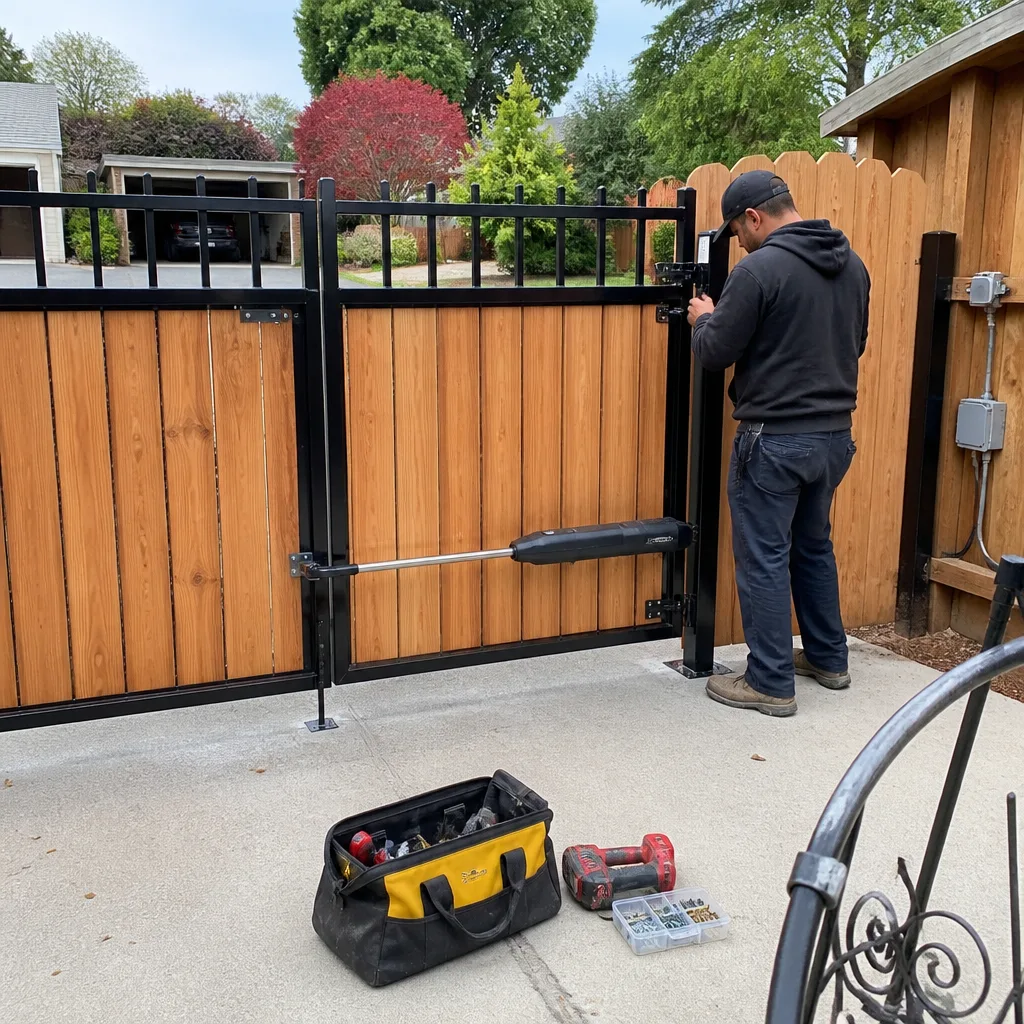 After
After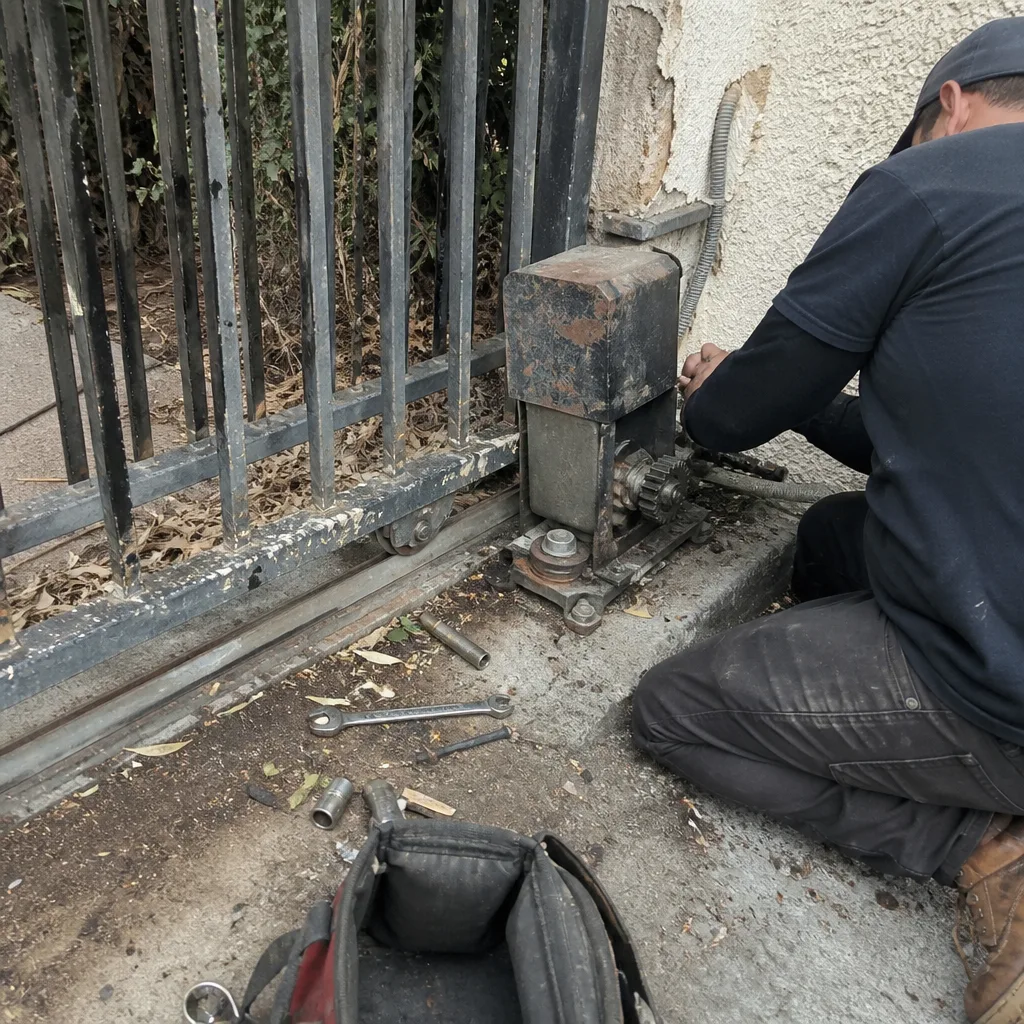 Before
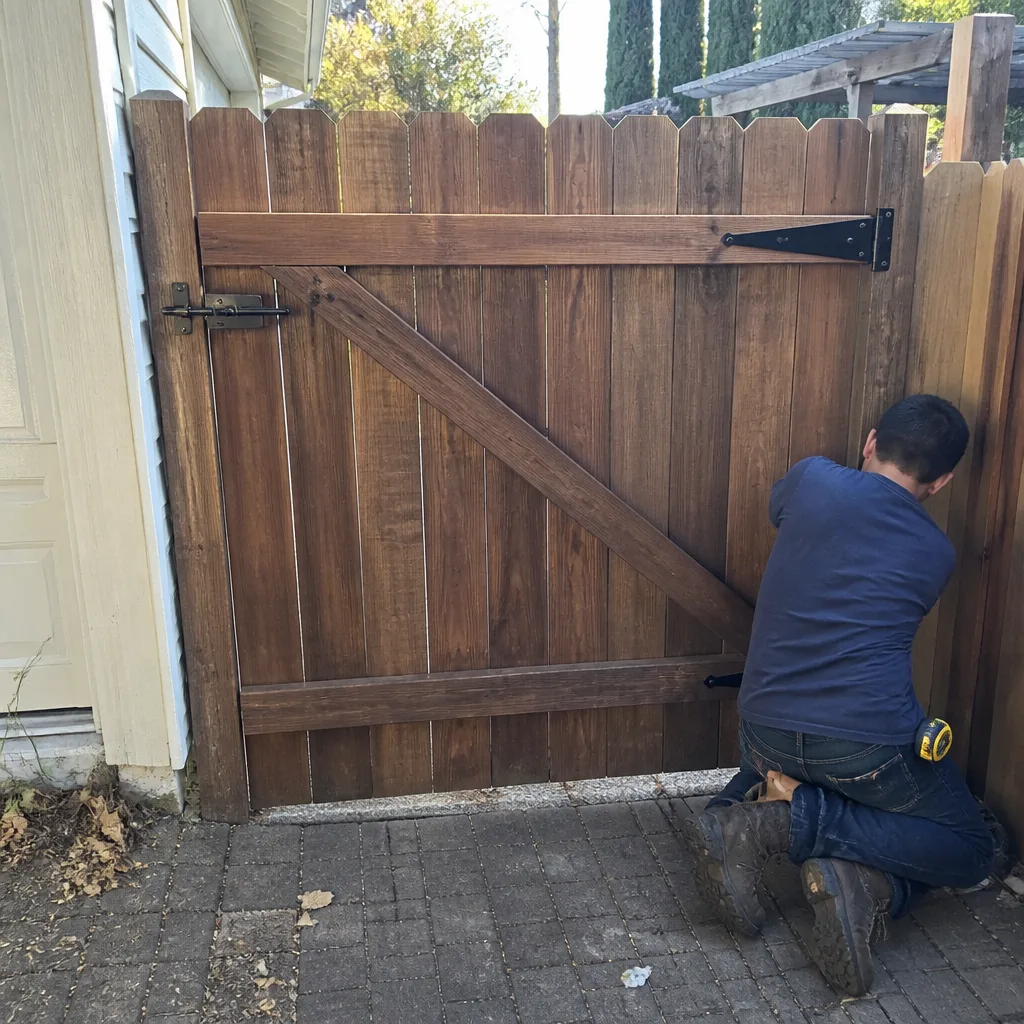 After
AfterDIY vs Professional Gate Repair: The Concord Homeowner’s Decision Guide
Here’s a distinction most Concord homeowners never hear until it’s too late: replacing your own gate roller is fixing hardware. Adjusting your own entrapment protection settings may be creating a UL 325 violation that voids your homeowner’s insurance claim if someone gets hurt. The DIY-versus-professional question for gate repair isn’t about whether you’re handy with tools. It’s about documentation liability and safety code compliance, two factors that change the calculus entirely when your gate is on a property you plan to sell, when children have access to your driveway, or when your insurance company asks for maintenance records after an incident. In this guide, we’ll draw the line based on those factors, not on difficulty. You’ll learn which repairs are genuinely safe to handle yourself in Concord, which ones trigger regulatory exposure, and why paying for our Gate Repair services for professional documentation is often the cheaper long-term decision even when the fix itself looks simple.
Quick Answer
Most Concord homeowners can safely handle basic gate maintenance like roller replacement, hinge pin swaps, and seasonal lubrication. Any repair touching entrapment protection systems, force settings, or electrical control boards should be left to a professional who can document UL 325 compliance and leave a written record. The dividing line isn’t skill, it’s liability: undocumented DIY adjustments to safety systems can invalidate insurance coverage and create seller-disclosure obligations.
Table of Contents
- What Makes Gates Different From Other Home Repairs
- Safe DIY Repairs for Concord Homeowners
- Repairs You Should Never DIY
- UL 325 and California Gate Safety Codes Explained
- The Hidden Costs of DIY: Documentation and Diagnostic Time
- What a Professional Repair Should Leave Behind
- The Cost Math: When DIY Saves Money and When It Doesn’t
- Concord-Specific Factors: Climate, Codes, and Property Values
BeforeAfterWhat Makes Gates Different From Other Home Repairs
We’ve repaired over 22,000 gates since 2014, and the pattern is consistent: homeowners who are perfectly competent with decks, drywall, or irrigation systems walk into gate repair with the wrong mental model. A gate isn’t a static structure. It’s a motorized machine with moving mass, electrical control systems, and federally regulated safety features that interact with each other in ways that aren’t visible to the eye.
Consider the difference between a fence post and a gate post. A fence post holds something in place. A gate post holds something that accelerates, decelerates, stops under load, and reverses when an obstruction is detected. The forces involved are substantial. A typical residential swing gate weighs 200-400 pounds. A sliding gate on a Concord hillside property can exceed 800 pounds. The motor and arm assembly generate torque that can crush a hand or pin a child against a vehicle before an adult can react.
The regulatory framework reflects this reality. Underwriters Laboratories standard 325 (UL 325) governs every automatic gate system sold in the United States. California adopted UL 325 by reference into the California Building Code, and Contra Costa County enforces it through permit inspections and plan review. The standard isn’t a suggestion. It’s incorporated by reference into your homeowner’s insurance policy, most of which contain exclusions for losses arising from “unauthorized modifications to safety equipment.”
This is why the DIY-versus-professional question for gates diverges so sharply from other home repairs. You can paint your own living room with zero regulatory exposure. You can replace your own sprinkler heads without affecting your title insurance. But when you open the control box on a gate motor in Concord and adjust the force settings, you’ve entered a regulated space with potential liability that extends years into the future.
The other distinction is documentation. When we complete a gate repair in Concord, we leave a photographed record of what was found, what was adjusted, and what was installed. Under Haven Standard Clause 4 (Evidence on every job), that documentation goes to the homeowner and into our job file. If the gate malfunctions three months later, we know exactly where the limit switches were set. If the homeowner sells the property, they have a maintenance record to disclose. A DIY repair, by definition, produces none of this. The knowledge lives in the homeowner’s head, and heads move, forget, or become unavailable at exactly the wrong moment.
Safe DIY Repairs for Concord Homeowners
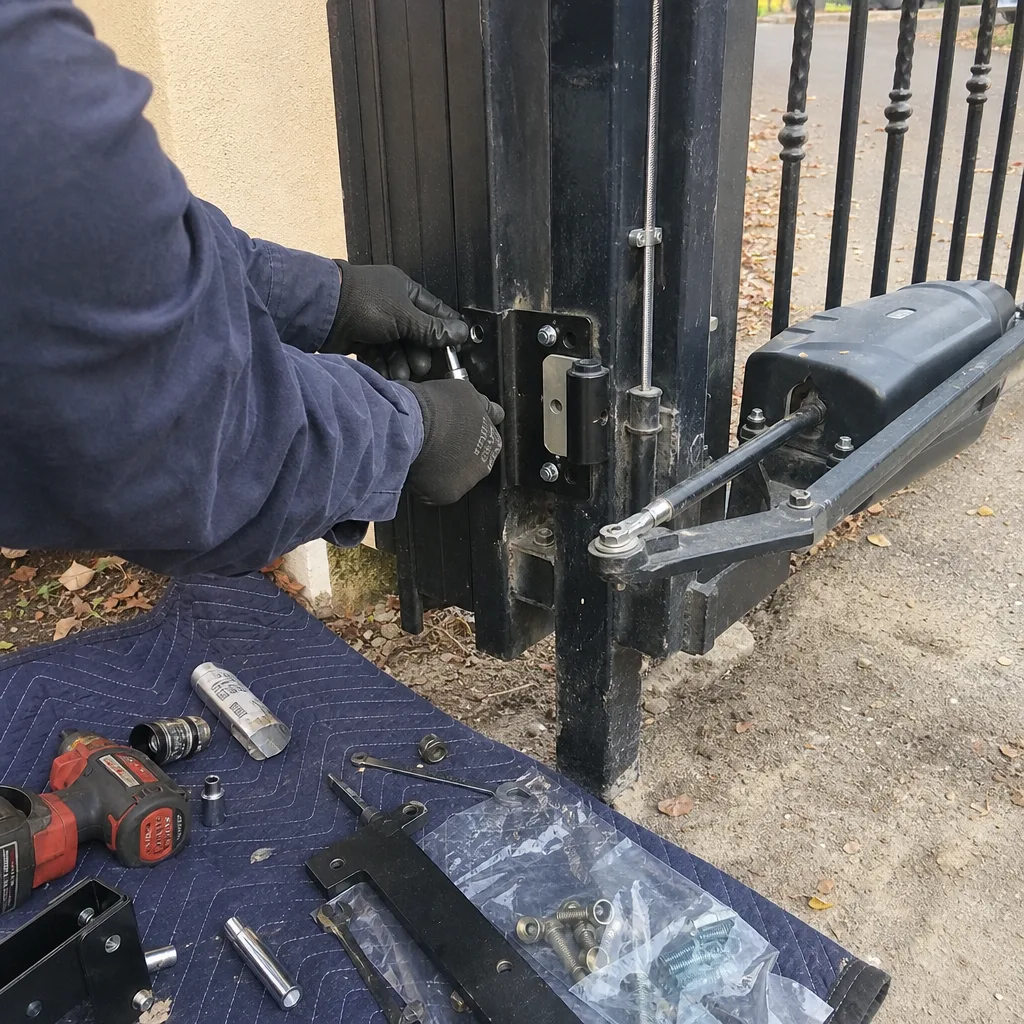
Not all gate work requires a professional. There is a clear category of maintenance and minor repair that a competent homeowner can handle safely, provided they stop at the boundary where electrical or regulated safety systems begin. Here’s what belongs in that category, and you’ll find more guides & resources on our blog.
1. Roller Replacement on Sliding Gates
Sliding gate rollers wear out predictably in Concord’s climate. The combination of dry summers, occasional winter moisture, and dust from nearby construction or hillside lots accelerates bearing failure. When a roller seizes or develops flat spots, the gate drags, the motor strains, and the track wears unevenly.
Replacing a roller is straightforward if you follow a specific sequence:
- Secure the gate in the open position with a locking prop or heavy-duty jack stand. Never rely on the motor brake alone.
- Disconnect power to the motor at the breaker, not just the remote.
- Support the gate frame with a floor jack and wooden block at the point nearest the failed roller.
- Remove the roller bracket bolts, extract the old roller, and install the replacement with the same bolt grade and torque.
- Lower the gate, verify smooth travel by hand, and restore power.
- Test the full open and close cycle three times before considering the job complete.
The critical safety step is the first one. An unsecured gate can roll on a slope, and many Concord properties on the east side of town have meaningful grade. We’ve responded to calls where a homeowner skipped the prop step and the gate pinned their leg against the fence line.
2. Hinge Pin and Bushing Replacement
Swing gate hinges wear at the pin and bushing interface. The symptom is vertical play, visible as a gap that opens and closes when you lift the free end of the gate. Left unaddressed, the misalignment stresses the gate motor arm and eventually damages the operator.
Pin replacement requires supporting the gate leaf, removing the old pin with a drift punch, and installing the new pin with proper lubrication. Use a lithium-based grease rated for outdoor exposure, not WD-40, which evaporates and leaves metal unprotected. In Concord’s summer heat, we’ve seen gates with dried-out hinge grease develop galling that seizes the pin entirely.
3. Seasonal Lubrication and Debris Clearing
This is the most valuable DIY maintenance and the most neglected. Every six months:
- Clear the gate track of leaves, gravel, and construction debris. In Concord’s Diablo-adjacent neighborhoods, oak catkins and acorns are particular track hazards in spring and fall.
- Lubricate the chain or rack with a dry-film lubricant if your gate uses a chain drive. Wet lubricants attract dust and form grinding paste.
- Inspect photo-eyes (the infrared beam sensors that stop the gate if something crosses the path) for misalignment, spider webs, or leaf coverage. Clean the lenses with a dry cloth only.
- Check the gate’s physical stops at full open and full close. If the gate is hitting the stop hard, the limit switches need professional adjustment, but identifying the symptom early prevents motor damage.
The boundary is clear: if your maintenance task doesn’t require opening the control box, adjusting dials, or interpreting LED fault codes, it’s generally safe DIY territory.
Repairs You Should Never DIY
There are three categories of gate repair where DIY work creates disproportionate risk relative to the apparent simplicity of the task. These are where we’ve seen homeowners cause the most expensive secondary damage and the most serious regulatory exposure.
Entrapment Protection Adjustments
Every automatic gate sold since 2000 must have entrapment protection. This takes one of three forms: contact sensors (safety edges that reverse the gate when pressed), non-contact sensors (photo-eyes), or inherent force limitation (the motor detects resistance and reverses). The sensitivity, response time, and reverse behavior of these systems are calibrated to UL 325 requirements.
When a homeowner adjusts the force setting on a control board to “make the gate close harder” because it’s stopping on a slight grade, they may be defeating the entrapment protection. When they reposition a photo-eye to stop the nuisance reversals without verifying the beam still covers the full hazard zone, they’ve created a blind spot. These adjustments seem minor. They’re not. They’re modifications to a safety system, and California courts have held homeowners liable for injuries resulting from unauthorized modifications to automatic door and gate systems.
Control Board and Limit Switch Work
The control board is the brain of the gate operator. It manages motor direction, speed ramping, force limiting, and communication with accessories. Limit switches tell the board where the gate is in its travel. When these drift or fail, the symptom is usually obvious: the gate doesn’t stop where it should, or it reverses unpredictably.
The temptation is to open the box and “tweak” the limit pots. Don’t. Modern operators from brands like Linear, Viking, and DoorKing store limit positions digitally, and the adjustment procedure requires entering a programming mode with specific button sequences. Older analog boards have physical pots that interact with each other. Turning the close limit without understanding its relationship to the slow-down point can cause the gate to slam at full speed. We’ve replaced $800 operators that failed because a homeowner’s limit adjustment caused repeated hard stops.
Spring and Counterbalance Work
Some heavy swing gates use torsion or extension springs to balance the load on the motor. These springs are under substantial tension. A spring replacement or tension adjustment requires winding bars, proper anchoring, and knowledge of the gate’s weight and moment arm. The energy stored in a wound gate spring can cause serious injury if released improperly. This is comparable to garage door spring work, which most homeowners already recognize as professional-only.
Welding and Structural Repair
Gate frame cracks, picket failures, and post weldments require structural welding. Even if you own a welder, gate welding involves galvanized steel (toxic zinc fumes), structural load calculations, and often work in the gate’s line of travel. We’ve been called to Concord properties where a homeowner’s weld held for three months, then failed catastrophically when the gate was under motor load, causing damage to the operator, the vehicle, or both.
UL 325 and California Gate Safety Codes Explained
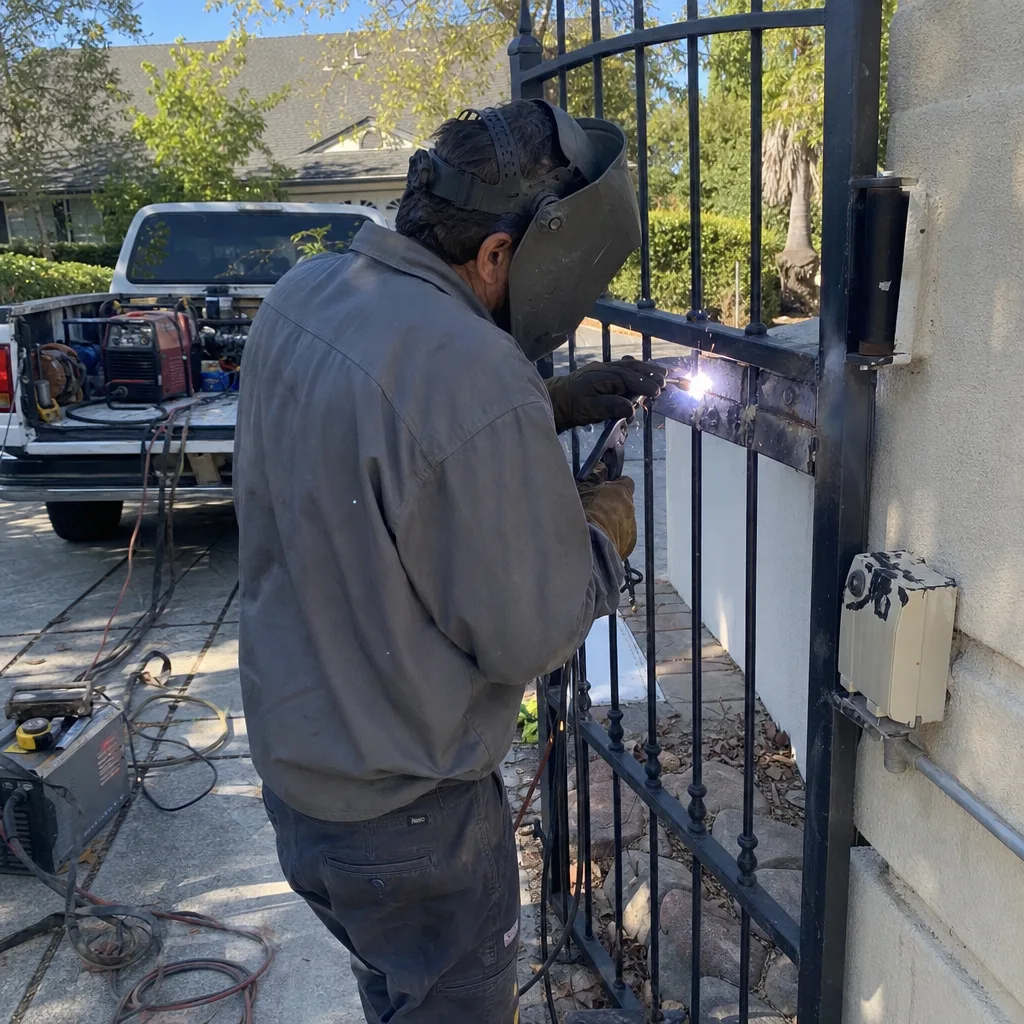
UL 325 is the specific regulation that transforms gate repair from a maintenance task into a compliance exercise. Understanding what it actually requires helps clarify why certain repairs are off-limits for DIY work.
The standard, now in its seventh edition, specifies minimum safety requirements for automatic gate operators. Key provisions include:
- Force limitation: a gate must reverse within 2 seconds when encountering an obstruction, and the force must not exceed specified limits (typically 40 pounds for sliding gates, with variations by gate type and entrapment zone).
- Entrapment protection: every gate must have at least one type of external entrapment protection (photo-eye or safety edge) in addition to the inherent force limitation.
- Warning signage: gates must display visible warnings about automatic operation.
- Installation documentation: the installer must provide the homeowner with safety instructions and maintenance requirements.
California’s adoption of UL 325 occurs through the California Building Code, Title 24, Part 2, Chapter 31B (specifically for swimming pool enclosures) and through general reference in local ordinances. Contra Costa County’s building department requires UL 325-compliant operators for all new gate installations and for replacement of failed operators on existing gates. The county does not routinely inspect residential gate repairs, but the standard becomes relevant in three specific Concord contexts:
Property sales. California’s Transfer Disclosure Statement (TDS) requires sellers to disclose known defects in automatic gates. A gate with modified or non-functional entrapment protection is a known defect. The seller who performed their own control board adjustments without documentation has no way to demonstrate compliance, and no way to pass liability to a prior professional.
Insurance claims. Homeowner’s policies typically exclude losses arising from code violations or unauthorized modifications. If a guest’s child is injured by a gate with a defeated photo-eye, the insurer’s first question will be who last serviced the gate and whether that service was documented. A DIY adjustment with no record is an uncovered exposure.
HOA and planned community requirements. Many Concord neighborhoods, particularly in the Clayton Valley and Turtle Creek areas, have HOA maintenance standards that reference UL 325 compliance. An undocumented repair can trigger violation notices and required remediation by a licensed contractor.
The practical implication: any repair that could affect force settings, entrapment protection sensitivity, or operator behavior must be performed by someone who understands UL 325, can verify compliance, and will document what was done. That’s not a skill issue. It’s a regulatory and liability issue.
The Hidden Costs of DIY: Documentation and Diagnostic Time
The most expensive DIY repair is the one that works temporarily, fails mysteriously, and requires a professional to diagnose what happened. We’ve seen this pattern repeatedly in Concord, and the cost multiplier is substantial.
Here’s a typical scenario. A homeowner’s sliding gate begins reversing before it reaches the closed position. They open the control box, find what they believe is the limit adjustment, and turn it clockwise. The gate now closes fully. Three weeks later, it doesn’t open. The motor runs but the gate doesn’t move. The homeowner calls us.
Our technician arrives and finds:
- The limit adjustment was actually the torque pot, not the close limit. The gate was closing under excessive force, which stripped the nylon gear in the operator.
- The original symptom, premature reversal, was caused by a misaligned photo-eye that the homeowner never checked.
- The gear damage is not field-repairable on this particular operator model. The entire operator requires replacement.
- Because the homeowner’s adjustment was undocumented, we have no baseline. We must diagnose from scratch, which adds 30-45 minutes to the service call.
The homeowner saved nothing. They spent their own time, destroyed a $600 operator, and paid for extended diagnostic labor. If they had called initially, we would have realigned the photo-eye in 15 minutes under our standard service rate, documented the adjustment under Haven Standard Clause 4, and the operator would have continued operating for years.
The documentation gap creates cost even when the DIY repair doesn’t cause damage. When we service a gate with no maintenance history, we must perform a full system inspection to establish baseline condition. That takes time. Time is labor. Labor is the primary component of gate service pricing. A gate with prior professional documentation, by contrast, allows us to target our inspection, verify that prior settings are still correct, and focus on the new symptom. The documented gate costs less to service over its lifetime, even accounting for the professional’s initial fee. For Gate Repair Cost Breakdown: The Concord Homeowner’s Reference for 2026, see our detailed pricing analysis.
This is particularly relevant in Concord’s older neighborhoods, like the homes near Todos Santos Plaza or in the Dana Estates area, where gates may be 20+ years old and have passed through multiple owners. A complete service history is rare. The homeowner who establishes documentation now creates value for themselves and for future owners.
What a Professional Repair Should Leave Behind
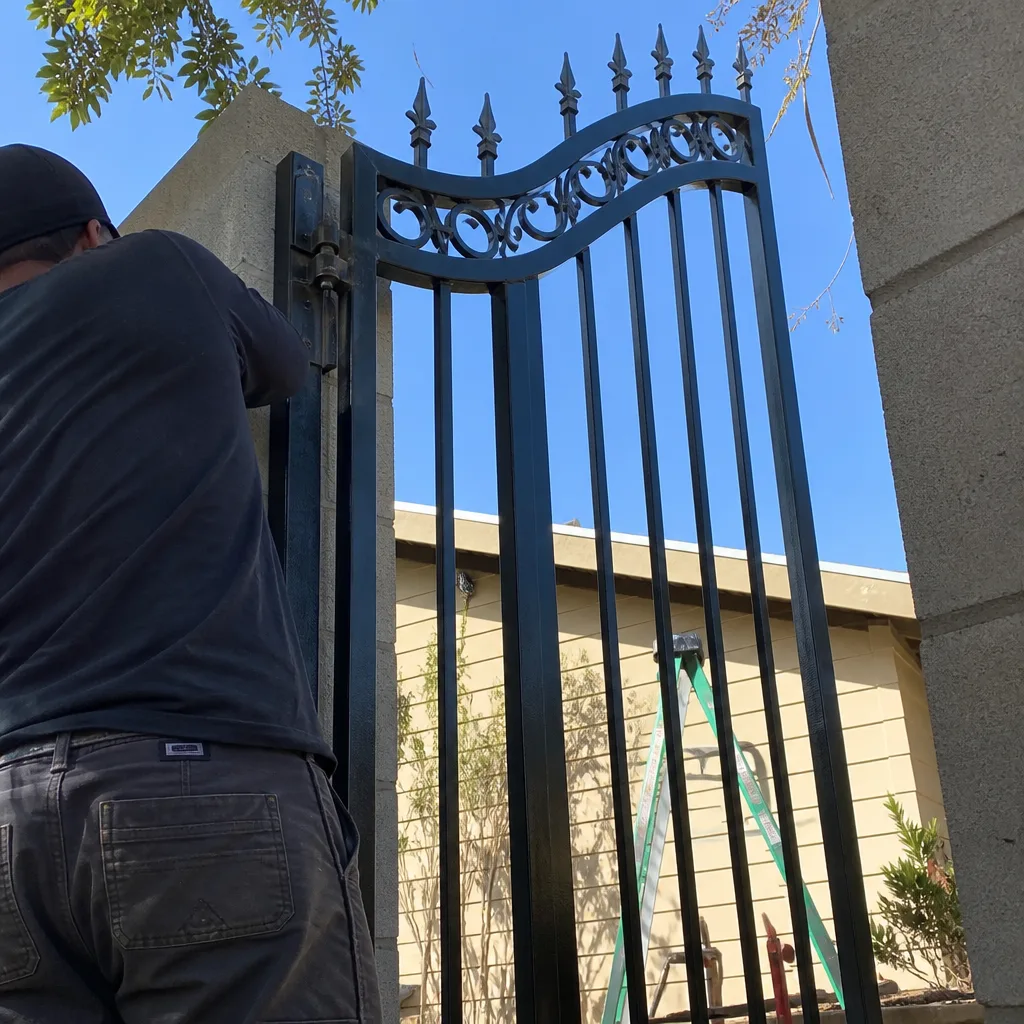
If you’re paying for professional gate repair, you should receive specific deliverables that a DIY repair cannot replicate. These aren’t luxuries. They’re the evidence that protects your liability position and reduces your lifetime service costs.
At Vance Gate Repair Concord, every visit governed by The Haven Standard produces the following:
Written scope and price before work starts. Under Clause 1, the technician provides a flat price in writing before picking up any tool. The homeowner approves or declines. There is no surprise invoice. There is no “it took longer than expected” upcharge. The price is the price.
Photographed record of findings. We photograph the gate condition, the control board settings, the photo-eye alignment, and any wear points. These images go to the homeowner and into our job file. If a dispute arises, the evidence exists. If a future technician needs to know where the limit switches were set, the photo shows them.
Wiring diagram annotation. For control board replacements, accessory additions, or troubleshooting of intermittent faults, we annotate or create wiring diagrams showing what connects to which terminal. This is the commercial access-control documentation habit that Adrian Vance developed starting in 2014, applied to residential gates. Most local gate companies don’t do this. We’ve inherited their jobs when the original technician left no record and no one else could figure out the wiring.
Limit switch and force readings. Where the operator displays or allows measurement of force and position data, we record the values before and after adjustment. This creates a quantitative baseline. “The close force was set to 28 pounds; we reduced it to 22 pounds to achieve reliable reversal on the safety edge test.” That’s documentation. “I tweaked it until it worked” is not.
Part numbers and warranty information. Every component installed is identified by manufacturer part number, with warranty terms noted. If a replacement photo-eye fails within its warranty period, you know exactly what to reference. If you sell the home, the buyer knows what was installed and when.
365-Day Done Right Promise documentation. Our warranty is not verbal. It’s written on the invoice, with the specific clause referenced. If the repair is not right, we make it right at no additional charge within one full year. No argument, no fee, no expiration date within that window.
These deliverables are why professional repair costs more than DIY. You’re not just buying the fix. You’re buying the record that the fix was correct, compliant, and performed by someone who can be held accountable.
The Cost Math: When DIY Saves Money and When It Doesn’t
The financial comparison between DIY and professional gate repair isn’t as straightforward as “my time is free.” You need to account for risk-adjusted cost, diagnostic legacy, and the value of documentation. Here’s how the math actually works.
When DIY Saves Money
DIY is the cheaper net option when all of the following are true:
- The repair is purely mechanical (roller, hinge, latch) with no electrical or safety-system component.
- You already own the necessary tools and don’t need to purchase specialized equipment.
- The gate is not on a slope or in a configuration where uncontrolled movement creates hazard.
- You have no near-term plans to sell the property, and no HOA compliance concerns.
- You can correctly identify the failed part and source the correct replacement.
In these cases, the only costs are parts and time. A $40 roller and two hours of Saturday morning is genuinely cheaper than a service call. The savings are real and unobjectionable.
When Professional Repair Is the Cheaper Long-Term Decision
Professional repair produces net savings when any of the following apply:
| Factor | DIY Cost Risk | Professional Advantage |
|---|---|---|
| Control board or limit work | High risk of operator damage ($400-$1,200 replacement) | Correct diagnosis, preserved operator, documented settings |
| Entrapment protection | Insurance voidance, liability exposure | UL 325 compliance verification, written certification |
| Intermittent fault | Multiple trial repairs, escalating parts cost | Systematic diagnosis, correct fix first time |
| Pre-sale property | Disclosure obligation, potential buyer credit demand | Documented maintenance record, transferable warranty |
| Gate under 5 years old | Manufacturer warranty voidance for unauthorized service | Warranty preservation, authorized parts |
The cost structure for professional service in the Concord market typically runs as follows. These are ranges based on our experience; your specific quote will depend on gate type, brand, and access conditions:
- Standard service call and diagnosis: $95-$150
- Roller replacement (parts and labor): $180-$280
- Photo-eye realignment or replacement: $140-$220
- Control board programming or limit adjustment: $160-$240
- Operator replacement (including removal, installation, and documentation): $800-$1,800 depending on brand and features
Notice that the professional service call includes diagnosis. If you DIY incorrectly and then call us, you pay for diagnosis plus whatever damage resulted. The “savings” evaporate quickly.
We also offer a free second opinion on any written estimate from another company. Bring the paperwork and we’ll review it at no cost. This is particularly valuable in Concord’s competitive gate service market, where we’ve seen estimates proposing full operator replacement for problems that required $120 in sensor work.
Concord-Specific Factors: Climate, Codes, and Property Values
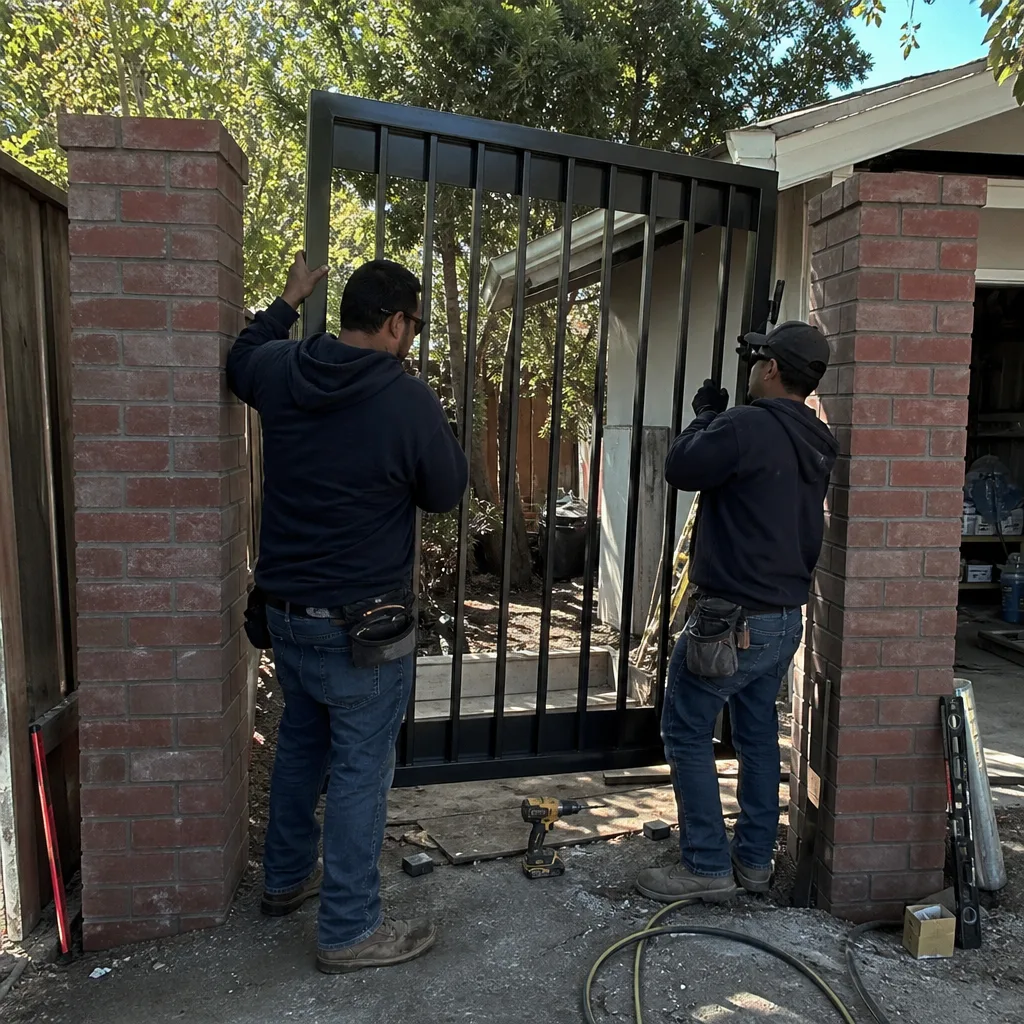
Concord’s particular conditions affect gate repair decisions in ways that don’t apply uniformly across the Bay Area. Local context matters for both DIY feasibility and professional service value.
Climate and material stress. Concord’s inland valley climate brings hotter summers and cooler winters than coastal Bay Area cities. Summer temperatures regularly exceed 90°F, and the dry heat accelerates grease breakdown, seal hardening, and plastic component fatigue. Gates on west-facing exposures, common in the Concord Hills and Dana Estates areas, take the brunt of afternoon sun. We’ve replaced control board capacitors that failed from accumulated heat exposure, and we’ve found photo-eye housings warped enough to misalign the beam. The homeowner doing seasonal maintenance needs to inspect for heat damage more frequently than the standard annual recommendation.
Soil and foundation movement. Concord sits on a mix of alluvial soils and bay mud, with significant expansion-contraction cycles during wet and dry seasons. Gate posts settle, shift, and tilt. A gate that operated smoothly in May may bind in October as the post leans. The DIY homeowner can sometimes address minor binding with hinge adjustment, but progressive foundation movement requires professional assessment of whether the post needs resetting or the gate frame needs modification. We’ve seen homeowners grind down binding edges repeatedly rather than address the underlying post movement, eventually ruining a gate that needed $400 in post work.
Property value and buyer expectations. Concord’s housing market, particularly in the $800K-$1.4M range where updated homes with automated gates are common, brings discerning buyers who request maintenance records. A gate with documented professional service is a selling point. A gate with a history of “I fixed it myself” is a disclosure risk. In competitive sales environments, the $200 professional service call that produced documentation can return multiples in buyer confidence and reduced negotiation.
Local code enforcement patterns. While Contra Costa County does not routinely inspect residential gate repairs, they do inspect new installations and permits for pool enclosures. Concord’s specific pool enclosure requirements, common in the Clayton Valley and Ayers Ranch areas, reference automatic gate compliance. A homeowner whose DIY repair affects a pool gate’s self-closing or latching function may face code compliance action if a child safety incident triggers inspection.
Brand distribution and parts availability. Concord’s gate automation market includes strong representation of LiftMaster, FAAC, and Linear from major distributors in the East Bay. Ghost Controls and Mighty Mule have retail presence through big-box stores. Viking and DoorKing are more commonly found on commercial and high-end residential installations. The DIY homeowner can source parts for the retail brands readily. For Viking, DoorKing, or older FAAC systems, professional distributors often have better parts access and technical support. We’ve inherited jobs where a homeowner spent weeks sourcing a discontinued control board that we could have replaced with a current-compatible unit in one visit.
Common Mistakes to Avoid
- Adjusting force settings to compensate for mechanical binding. When a gate drags or binds, the correct fix is mechanical: rollers, hinges, track, or post. Increasing motor force to overcome binding overloads the operator and defeats entrapment protection. We’ve replaced operators in Concord’s Holbrook Heights neighborhood where this exact mistake destroyed a $900 Viking unit.
- Using the wrong lubricant. WD-40 is not a lubricant for gate components; it’s a water displacer that evaporates. In Concord’s dry heat, it leaves metal unprotected. Use lithium grease for hinges and dry-film lubricant for chains. We’ve seen gates in the Dana Estates area with galled hinge pins from WD-40 use.
- Ignoring photo-eye alignment after landscape changes. New plantings, mulch buildup, or sprinkler adjustments can shift or obscure photo-eyes. The homeowner who bypasses the photo-eye rather than realigning it has created a UL 325 violation. We find this most often after spring landscaping projects in Concord’s newer developments.
- Assuming all operators adjust the same way. A Linear control board programs differently from a DoorKing, which programs differently from a Ghost Controls unit. The button sequences in a YouTube video for one brand can factory-reset another. We’ve recovered gates that were rendered inoperable by cross-brand DIY programming attempts.
- Working alone on heavy gates. Even “light” residential gates weigh enough to cause serious injury if they shift unexpectedly. The homeowner who props a gate with a cinder block rather than a proper jack stand is taking a risk that no time savings justifies. We’ve responded to emergency calls for injuries that were preventable with basic support equipment.
- Not verifying power isolation. Gate operators store energy in capacitors and can move unexpectedly even with the remote disabled. Always disconnect at the breaker, not just the control. This is particularly important with older Concord installations that may lack modern disconnect switches.
- Discarding documentation from prior professionals. The maintenance record, warranty card, and installation manual are property assets. We’ve had Concord homeowners pay for duplicate diagnostic work because they couldn’t locate the prior service record that would have told us exactly when the operator was installed and what was last adjusted.
When to Call a Professional
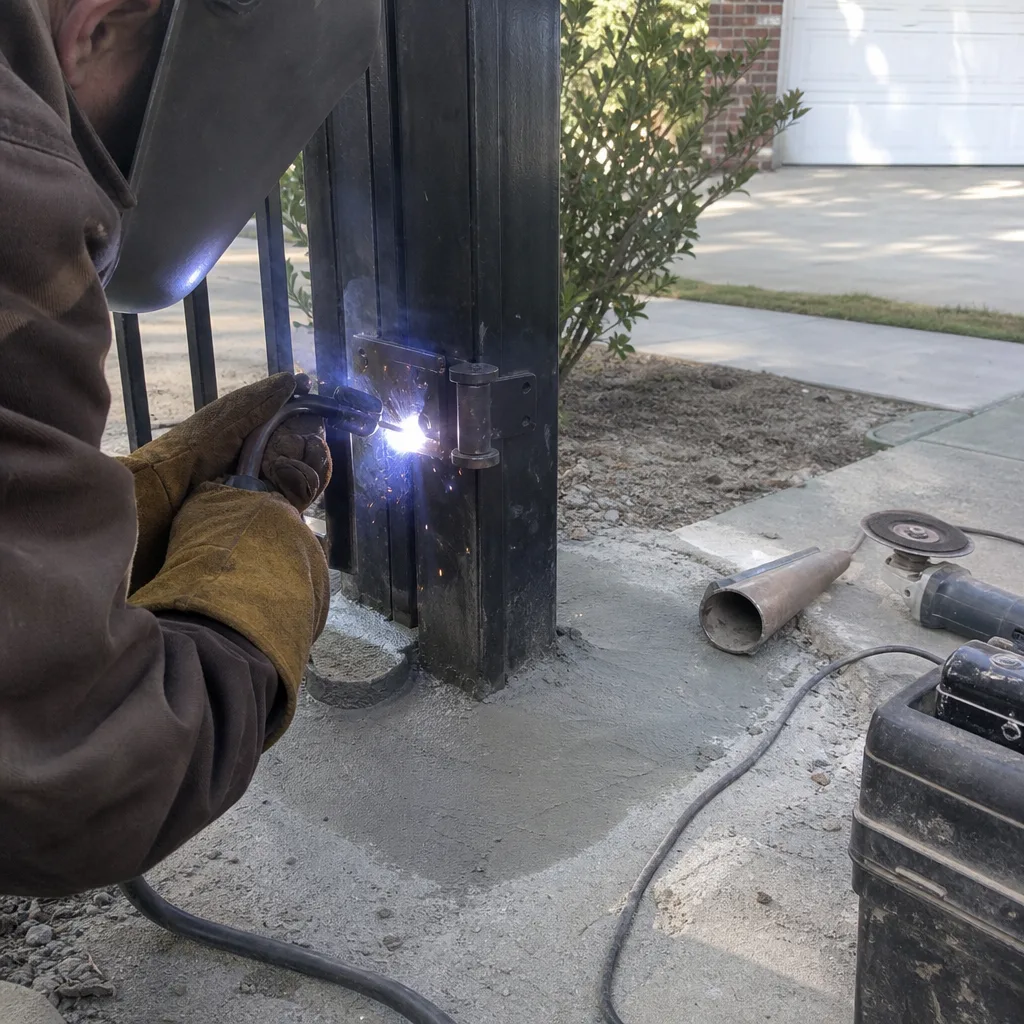
Call a professional when the repair touches electrical systems, safety settings, or code compliance, or when the gate’s behavior is intermittent and unexplained. Call when you’re preparing to sell the property and need documented maintenance history. Call when the gate is under manufacturer warranty and unauthorized service would void coverage. Call when you’ve attempted DIY repair and the problem persists or worsens, because continued trial-and-error typically increases the eventual professional cost.
Vance Gate Repair Concord offers free estimates in Concord. We’ll assess your gate, provide a written price before any work starts under Haven Standard Clause 1, and leave you with a documented record of what we found and what we did. Call (510) 726-7050 to schedule.
Frequently Asked Questions
Most residential gate repairs in Concord range from $140 for minor adjustments to $340 for component replacement, with operator replacements running $800-$1,800 depending on brand and features. We provide a written, flat price before any work begins. Call (510) 726-7050 for an exact quote on your specific gate - estimates are free.
You can legally perform mechanical repairs like roller and hinge replacement on your own property. However, any modification to entrapment protection systems, force settings, or control board programming may violate UL 325 and create liability exposure. California does not require a license for residential gate repair, but the work must comply with adopted safety standards. For code-regulated systems, professional documentation protects your legal position.
It depends on what you repair. Mechanical maintenance generally does not affect coverage. Modifications to safety systems without professional documentation can void coverage for gate-related incidents. Most policies contain exclusions for losses arising from code violations or unauthorized modifications to safety equipment. If someone is injured by a gate with DIY-adjusted force settings, your insurer may deny the claim.
Test monthly by placing a solid object like a cardboard box in the gate’s path during closing. The gate should reverse within 2 seconds and not exceed gentle contact force. For photo-eyes, break the beam with your leg during closing; the gate should stop and reverse immediately. If either test fails, or if you’ve adjusted settings to “make it work,” call for professional service. Do not attempt to recalibrate these systems yourself.
You should receive a written scope and price before work starts, a written invoice with part numbers and warranty terms, and photographic or diagrammatic record of what was found and adjusted. Under The Haven Standard, we provide all of these on every visit. If your current gate company doesn’t document their work, you’re paying for labor without buying the record that protects your future liability.
We service nine major automation brands: LiftMaster, FAAC, BFT, Linear, Viking, Ghost Controls, DoorKing, Elite, and Mighty Mule. We do not steer customers toward replacement with a “preferred” brand when their existing operator can be repaired. Our technicians carry diagnostic tools and common parts for all nine brands. For new gate installation in Concord, we recommend based on your specific gate configuration and usage pattern, not on brand exclusivity.
The Bottom Line
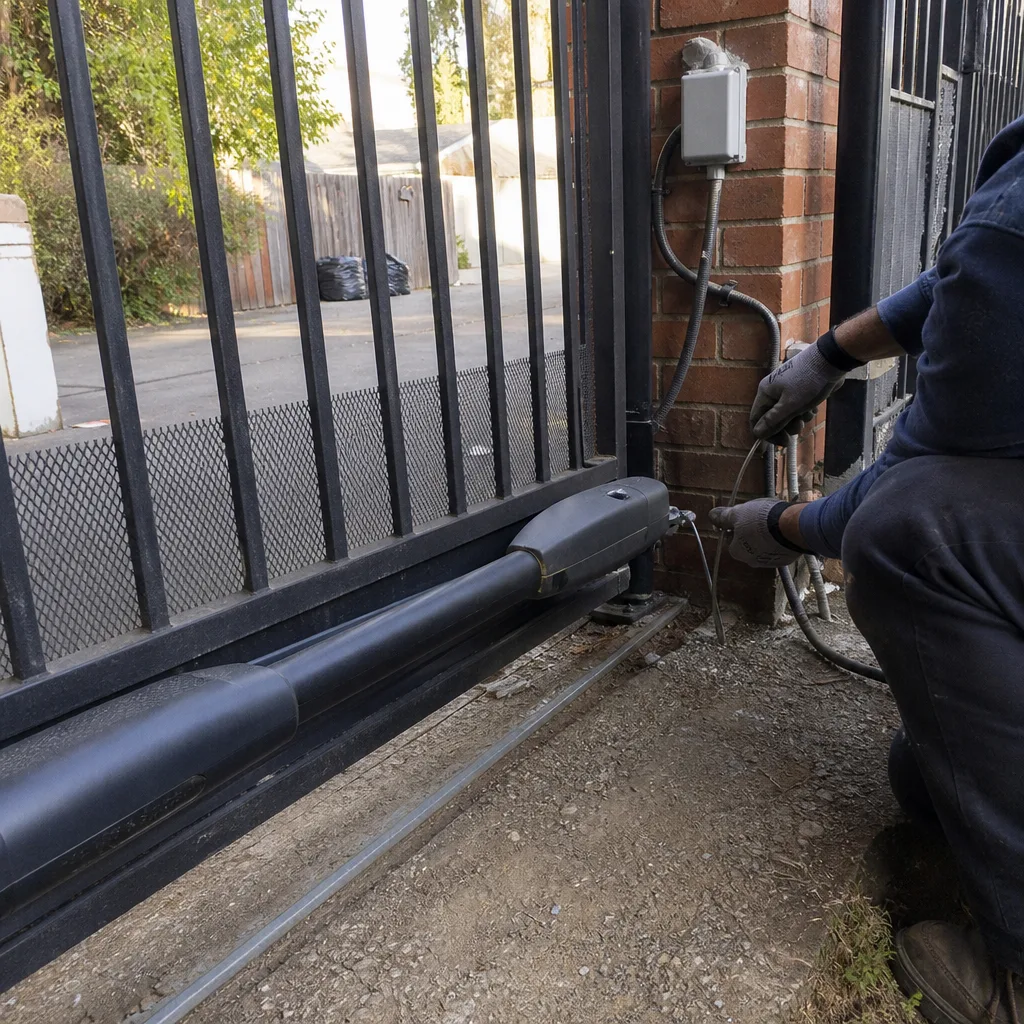
The DIY-versus-professional question for gate repair in Concord comes down to three factors: whether the repair touches regulated safety systems, whether you need documentation for liability or resale purposes, and whether the apparent simplicity of the fix hides interaction effects that could cause expensive secondary damage. Basic mechanical maintenance is safe DIY territory. Anything involving electrical control, force settings, or entrapment protection belongs with a professional who will leave a written record. The money you save on a DIY control board adjustment can be erased tenfold by a single insurance voidance or operator replacement. Pay for documentation when the stakes are high, do your own rollers when they’re not, and never confuse the two categories.
Written by Adrian Vance, Owner at Vance Gate Repair Concord, serving Concord since 2014.